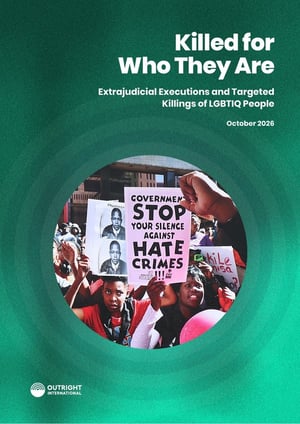
The report compiles killings where state authorities, civil society organizations, or victims' families have reason to believe the person was killed because of their actual or perceived sexual orientation, gender identity, gender expression, or sex characteristics. It focuses on January 2020 to July 2026 and builds on Outright's 2024 submission to the UN Special Rapporteur on extrajudicial, summary, or arbitrary executions.
Cases come from publicly available reports by international bodies, credible media in many languages, journalists, and civil society organizations, and were cross-referenced across sources. Media reports may contain errors about a victim's name, age, gender identity, or sexual orientation; Outright has corrected these where possible, but some details may not be exact.
On violence and identity
Most documented cases involve gay, bisexual, or queer men and trans women, who are often the most visible targets of men enforcing gender norms, and frequently among the most economically precarious. Documented cases of killings of lesbian, bisexual, and queer women are often linked to bias-motivated sexual assault and include cases perpetrated by family members and by men who were their former intimate partners. It is likely undercounted, as is violence against trans men.
On language
Outright uses "LGBTIQ" when an event or law genuinely includes the full range of identities, and terms like "queer," "sexual and gender minorities," or "people of queer experience" otherwise. When citing other sources, the report uses their terms.